M4A: The Track YouTube Already Has
M4A is YouTube's own AAC audio, usually about 128kbps, copied into a file with no second compression. About 58 MB per hour. It plays on iPhone, Mac, Android and Windows.
YT audio download: MP3 or M4A
To download the audio from a YouTube video, paste its link into the box at the top of this page and choose a format. Pick MP3 at 128, 192 or 320kbps for the widest compatibility, or M4A to keep YouTube's original AAC track without re-encoding. Press Download and the sound file saves to your device.
How to
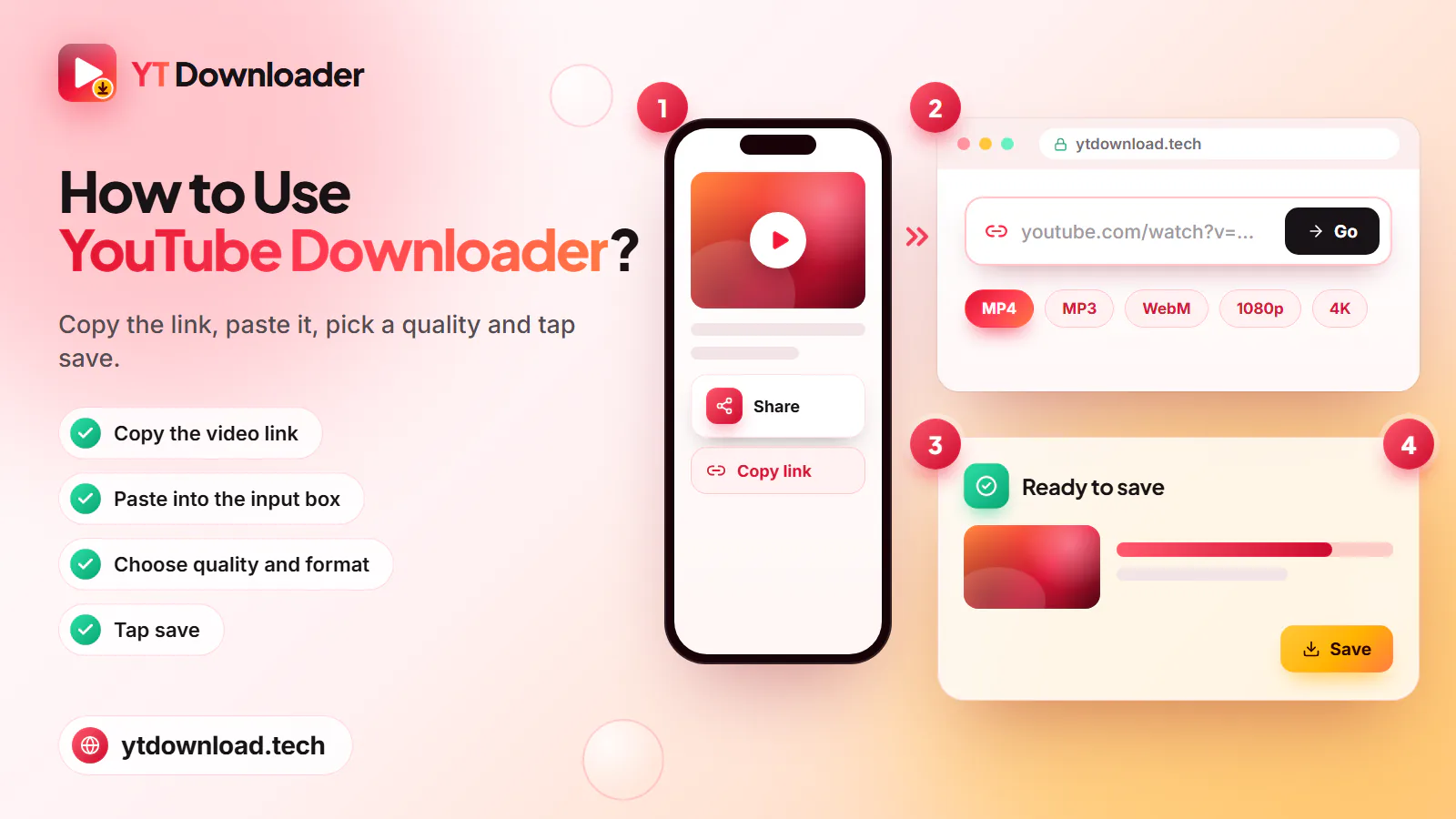
To download the audio from a YouTube video, paste its link into the box at the top of this page and choose a format. Pick MP3 at 128, 192 or 320kbps for the widest compatibility, or M4A to keep YouTube's original AAC track without re-encoding. Press Download and the sound file saves to your device.
Only the sound is saved, so an hour-long lecture that would be hundreds of megabytes as video becomes a file of roughly 58 to 144 MB as MP3, or about 58 MB as M4A. It plays with the screen off and needs no signal once it is on your phone.
The decision
Both are compressed formats, and both sound clean for speech. The choice comes down to three things: whether the audio is re-encoded, what will play it, and how long the recording is.
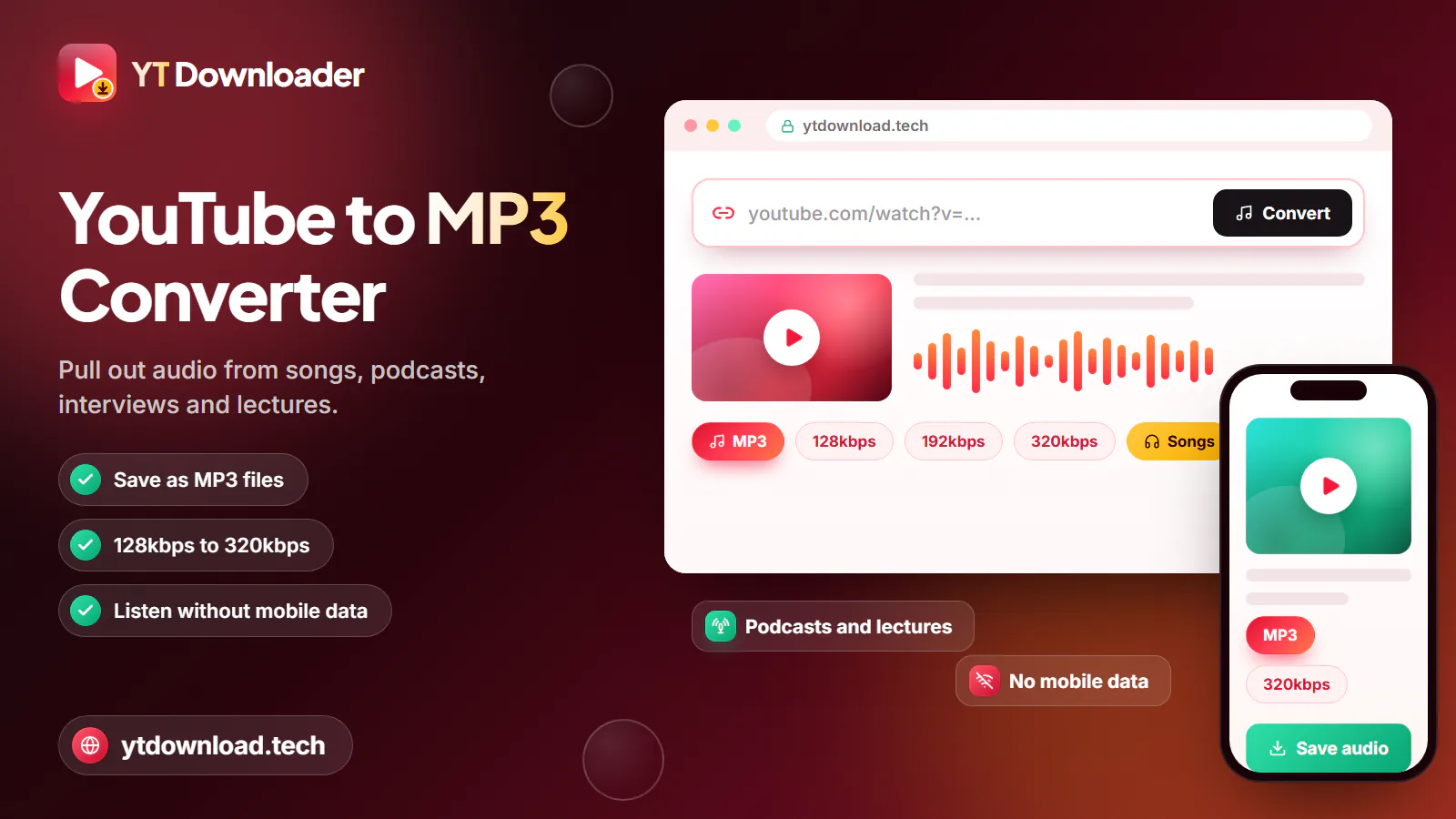
M4A is YouTube's own AAC audio, usually about 128kbps, copied into a file with no second compression. About 58 MB per hour. It plays on iPhone, Mac, Android and Windows.
MP3 is re-encoded at the bitrate you choose: about 58 MB per hour at 128kbps, 86 MB at 192kbps and 144 MB at 320kbps. Pick it for older car stereos, basic MP3 players and smart speakers.
MP3 conversion is limited to audio of about three hours. M4A is copied rather than converted, so a five-hour livestream replay or conference recording can still be saved when an AAC track exists.
MP3s get the title and artist from the video; M4A files are saved without tags. And a 320kbps MP3 cannot sound better than the upload it was made from.
Recommended settings
What to choose for the kind of audio you download most.
MP3 at 128kbps is plenty for voices and keeps a week of episodes small. Choose 192kbps if the show leans on music.
M4A or 128kbps MP3. A recorded college lecture gains nothing from 320kbps, and a three-hour seminar is more reliable as M4A.
128kbps MP3 for public-domain readings you play in the car or on a run. If a reading runs past three hours, save it as M4A.
128kbps MP3 plays on the simplest devices, which helps when you share a church's own recordings with family who use older phones.
M4A for the most faithful copy, or 320kbps MP3 when the file must play on a USB stick in the car.
Download on Wi-Fi before you leave. Audio plays offline, so a cross-country flight or a long drive through spotty coverage does not eat into your data plan.
Finding your file
On iPhone and iPad, Safari saves audio to the Files app: open Files, tap Browse, then Downloads. Tap the file to play it, or use Share to open it in another app. Files stored there do not appear in the Music app automatically; to add them to your library, sync them from a Mac with Finder or from a Windows PC.
On Android, the file goes to the Downloads folder, and most music and podcast players list it straight away. On Windows, Mac, Chromebook and Linux it lands in the Downloads folder of your browser.
There is no app or browser extension to install, and the downloader saves one link at a time, so for a series of episodes, copy and save each one in turn. Private, members-only, age-restricted and region-blocked videos cannot be saved. Save only audio you own, have permission to keep, or that is Creative Commons, public domain or royalty-free, and follow US copyright law and YouTube's Terms of Service.
Questions
Copy the video link, paste it into the box at the top of this page and press Download. Choose MP3 with a bitrate, or M4A for the original track, then save the file. It works the same on a phone and a computer.
Choose MP3 or M4A instead of MP4. Only the sound is saved, without the picture, so the file is a fraction of the size of the video and plays in any audio app.
Save as M4A for the most faithful copy, since it is YouTube's original audio with no re-encoding. Save as MP3 when the file must play on an older car stereo or MP3 player, or when you want title and artist tags. For speech, you will not hear a difference.
Yes, in Safari, with no app to install. Paste the link, pick MP3 or M4A and press Download, then find the file in the Files app under Downloads. From there you can play it or share it to another app.
MP3 conversion handles audio up to about three hours. M4A is copied rather than converted, so longer recordings can be saved as M4A when the video has an AAC track. Very long files take longer to prepare, so keep the page open.
Paste a YouTube link and keep the sound as an MP3 up to 320kbps or the original M4A, ready for the car, the gym or a flight. Free, no app, no sign-up.
Updated